-
seoteam
- September 15, 2026
- No Comments
Not every cut, scrape, or minor injury requires a trip to the doctor. Most small wounds can be cleaned and covered at home, and with proper care, they tend to heal without complications. But some wounds are more serious than they initially appear — and delaying professional assessment can allow problems to worsen in ways that are entirely preventable.
Knowing when a wound has crossed the line from something you can monitor at home to something that warrants professional attention is not always straightforward. The wound’s appearance at the time of injury does not always tell the full story. Pain, location, your general health, and how the wound is progressing over time all matter.
This article outlines 10 signs a wound needs professional medical attention, along with clear guidance on when that means calling emergency services, visiting a GP or urgent care centre, or arranging professional wound management support. Understanding the difference between these pathways can help you respond appropriately — and get the right level of care at the right time.
Medical disclaimer: This article is intended for general informational purposes only. It does not constitute medical advice and should not be used as a substitute for professional medical assessment. If you are concerned about a wound, please seek advice from a qualified healthcare professional. In an emergency, call 000 immediately.
When Does a Wound Need Professional Medical Attention?
The severity of a wound is not always obvious at first glance. A wound that appears small on the surface may be deeper than it looks, while a larger wound may be relatively straightforward to manage if it is clean, shallow, and in a low-risk location.
Several factors influence whether a wound warrants professional assessment:
| Factor | Why It Matters |
| Depth and size | Deeper or larger wounds carry a higher risk of complications and may require closure |
| Location | Wounds near joints, the face, hands, or feet can be more complex to manage |
| Bleeding | Persistent or heavy bleeding may indicate injury to deeper structures |
| Signs of infection | Redness, warmth, swelling, pain, and discharge can all indicate infection |
| Healing progress | A wound that is not improving as expected should be assessed |
| Underlying health conditions | Conditions such as diabetes and poor circulation can affect healing significantly |
| Age and skin fragility | Older adults and people with fragile skin may need extra support |
| How the injury occurred | Bites, puncture wounds, and contaminated injuries carry greater infection risk |
| Ongoing pain or swelling | Worsening symptoms often indicate a complication developing |
If you are unsure whether a wound is healing normally, getting professional advice is a safer approach than simply waiting to see what happens. Early assessment can help identify problems before they become more serious.
Some Wounds Need More Than a Bandage
Wound management is more involved than applying a dressing and hoping for the best. For wounds that are complex, chronic, or slow to heal, professional wound care can involve a thorough assessment, appropriate dressing selection, infection monitoring, and identifying factors that may be interfering with the healing process.
For some people — particularly those recovering from surgery, living with chronic wounds, or managing health conditions that affect healing — professional wound care provided in the home can make a meaningful difference to their recovery and quality of life.
1. The Wound Is Deep, Large, or Gaping
One of the clearest signs a wound needs professional medical attention is its size and depth. A wound that is deep, wide, or has edges that remain separated rather than coming together naturally may require professional assessment and, in some cases, wound closure.
Wounds in this category include:
- Deep cuts that extend through the skin and into underlying tissue
- Gaping wounds where the wound edges do not stay together
- Large open wounds that cover a significant surface area
- Wounds where deeper tissue is visible, such as fat, muscle, or bone
- Wounds that may require closure through suturing, stapling, or adhesive strips
- Injuries caused by significant trauma, such as falls, accidents, or machinery
Why Deep Wounds Should Be Assessed
The visible surface of a wound may not reflect what has occurred at a deeper level. Structures beneath the skin — including nerves, tendons, blood vessels, and muscle — can be affected by a wound that looks relatively minor on the outside.
A professional wound assessment can help determine the full extent of a wound and identify whether it requires closure or more specialised management. If you are unsure how deep a wound is, it is worth having it assessed sooner rather than later.
For information about professional wound care available in Bundaberg and the Wide Bay, CLM Community Support’s wound care services may be a relevant option for people who need ongoing wound assessment and management at home.
2. Bleeding Will Not Stop
Persistent bleeding is an important warning sign that a wound may need more than basic first aid. While some bleeding is a normal and expected part of sustaining a wound, it should generally slow and stop with appropriate direct pressure applied over a reasonable period.
Signs that bleeding warrants professional attention include:
- Bleeding that continues despite firm, consistent direct pressure
- Heavy bleeding that is difficult to control
- Blood repeatedly soaking through dressings
- Blood that is pulsing or spurting rather than flowing steadily
- Bleeding associated with a significant injury
When Bleeding Is an Emergency
Heavy or uncontrolled bleeding can be a medical emergency. If a wound is bleeding severely, if blood is spurting, or if the person is showing signs of significant blood loss — such as dizziness, pallor, weakness, or loss of consciousness — call 000 immediately.
Severe bleeding requires emergency medical treatment. It is not appropriate to wait for a scheduled wound care appointment in this situation. A professional wound care service is not a substitute for emergency medical treatment.
For first aid advice including guidance on managing bleeding, Healthdirect Australia provides reliable, evidence-based information.
3. You Can See Signs of Infection
Wound infection is one of the most important complications to identify early — and recognising the signs of an infected wound is something that can make a real difference to outcomes. This is also a significant reason why people in Bundaberg and the Wide Bay seek professional wound assessment and management.
Warning signs of wound infection include:
- Increasing redness around or spreading from the wound
- Warmth in the skin around the wound site
- Increasing swelling that is not improving
- Worsening pain rather than gradual improvement
- Pus or unusual discharge coming from the wound
- Foul smell from the wound or wound dressings
- Redness spreading away from the wound, sometimes in streaks
- Fever, chills, or feeling generally unwell
If you are noticing any of these wound infection symptoms, professional assessment is strongly recommended.
What Does an Infected Wound Look Like?
Infection does not always develop dramatically. In many cases, it develops gradually — which is why changes over time matter as much as the wound’s initial appearance.
A wound that is becoming increasingly painful, more swollen, warmer to the touch, or producing more discharge than previously is signalling that something may be changing. Redness that is spreading beyond the immediate wound site is a particularly important warning sign that warrants prompt assessment.
A wound that is infected should not be left to resolve without professional assessment, as untreated infection can worsen and potentially spread.
Why Early Wound Assessment Matters
Identifying infection early allows for appropriate management before complications develop. This is one of the key reasons why professional wound assessment is valuable — a qualified healthcare professional can assess the wound, monitor changes, and help determine the most appropriate course of action, including whether a GP referral or antibiotic treatment may be needed.
4. The Wound Is Not Healing
Wounds should generally show signs of progress. Edges should gradually draw together, drainage should reduce over time, and pain should ease. A wound that remains unchanged over several days, or that appears to be getting worse rather than better, warrants professional assessment.
Signs a wound is not healing properly include:
- Little or no improvement in the wound’s appearance over time
- The wound repeatedly reopening after it appears to have closed
- Persistent drainage that is not reducing
- The wound increasing in size rather than gradually closing
- New areas of tissue damage appearing near the original wound
- Continued pain that is not easing with time
- Wound edges failing to close or draw together
Why Some Wounds Take Longer to Heal
Wound healing is a complex process, and a range of factors can affect how quickly — or whether — a wound progresses. These can include:
- Age: Skin repairs itself more slowly as we get older
- Poor circulation: Adequate blood flow is important for healing
- Diabetes: People with diabetes may experience wound healing problems and are at greater risk of wound complications
- Infection: Active infection interferes significantly with healing
- Reduced mobility: Movement helps promote circulation and wound health
- Nutrition: Adequate protein, vitamins, and minerals support wound repair
- Pressure: Wounds that are subject to continued pressure, such as pressure injuries, may struggle to heal
- Certain medications: Some medications can affect immune response or tissue repair
- Underlying health conditions: Various chronic health conditions can influence how well wounds heal
It is important to note that the presence of any one of these factors does not automatically mean a wound will heal poorly — but they can increase the likelihood that professional assessment and monitoring will be beneficial.
When a Non-Healing Wound Needs Assessment
If a wound is not progressing as expected, it should be assessed by an appropriate healthcare professional. A GP can help determine whether there is an underlying cause for the delay in healing, whether infection is present, and whether specialist chronic wound care is appropriate.
Chronic and non-healing wounds are a particular area of focus for professional wound care services. For more information about chronic wounds and delayed healing, Healthdirect Australia provides accessible information on this topic.
5. The Pain Is Getting Worse Instead of Better
Some discomfort following an injury is entirely expected, particularly in the first day or two. But pain that is intensifying rather than gradually easing is a reason to take note — and potentially seek professional assessment.
Concerning patterns include:
- Pain becoming progressively worse over hours or days
- Pain that seems disproportionate to the size or nature of the wound
- New pain appearing after initial improvement, which can suggest a complication has developed
- Pain combined with redness, swelling, heat, or discharge, which may indicate infection
- Pain that is significantly interfering with sleep or normal daily activities
What Increasing Wound Pain Can Mean
Worsening pain is the body’s way of signalling that something may not be right. Pain can accompany infection, inflammation, tissue damage, or other complications. Rather than simply managing pain with over-the-counter medication and hoping for improvement, it is worth seeking assessment of the underlying cause — particularly if the pain is worsening or accompanied by other changes in the wound.
6. The Skin Around the Wound Is Becoming Red, Swollen, or Hot
While some mild redness or swelling immediately around a wound is a normal part of the early healing response, skin changes that are increasing rather than settling deserve attention. This is worth distinguishing from an infection section because these signs are often the earliest visible indicators of a developing problem — ones that people can easily observe themselves.
The distinction worth understanding:
- Mild, stable redness directly at the wound edge, present in the first day or two, is often a normal part of healing
- Redness that is spreading beyond the wound edge, or increasing over time, is more concerning
- Increasing warmth in the surrounding skin
- Significant or worsening swelling that is not settling
- Skin becoming increasingly tender to touch around the wound
Watch for Changes Around the Wound
Rather than focusing solely on the wound itself, it helps to monitor the surrounding skin as well. Changes in colour, temperature, firmness, and tenderness in the tissue around a wound can indicate that something is developing — even when the wound surface itself appears relatively unchanged.
If redness is spreading rapidly, or if systemic symptoms such as fever or feeling unwell are present alongside skin changes, prompt medical assessment is recommended rather than a routine wound care appointment.
7. The Wound Has a Bad Smell or Unusual Discharge
Changes in wound drainage — its amount, colour, consistency, or odour — can provide useful information about what is happening within the wound. Sudden or significant changes in discharge should not be dismissed.
Signs that warrant professional assessment include:
- Pus — thick, cloudy discharge from the wound
- New or increasing drainage after a period of improvement
- Foul odour from the wound or from wound dressings
- Green, yellow, or otherwise unusual discharge that was not present before
- Increasing moisture around the wound after a drier phase
Is Wound Drainage Always a Sign of Infection?
Not necessarily — and this distinction matters. Some wounds naturally produce fluid as part of the healing process. Clear or pale yellow fluid (known as exudate) can be a normal feature of wound healing, particularly in the early stages.
However, a sudden change in the amount of drainage, a shift in colour or consistency, or the development of a foul smell are all changes that warrant professional assessment. A qualified healthcare professional can help distinguish between normal wound exudate and drainage that suggests infection or other complications.
8. The Wound Was Caused by an Animal Bite, Human Bite, or Dirty Object
The circumstances surrounding an injury matter as much as the wound’s appearance. Some wounds carry a higher risk of infection or deeper tissue damage based simply on how they occurred — regardless of how minor they may look on the surface.
Wounds that should always receive professional medical assessment include:
- Animal bites — including dog bites, cat bites, and bites from wildlife
- Human bites — which carry a particularly high risk of infection
- Puncture wounds — which may be deeper than they appear and difficult to clean thoroughly
- Injuries involving contaminated objects — rusty metal, soil-covered tools, or materials of unknown cleanliness
- Wounds exposed to dirt, animal faeces, or other contaminants
- Injuries where a foreign object may remain embedded in the wound
Why the Cause of the Wound Matters
Bite wounds and puncture wounds can introduce bacteria deep into the tissue, where they are difficult to remove by surface cleaning alone. This can lead to serious infections that are not always immediately apparent at the wound surface.
Injuries involving contaminated objects also raise the question of tetanus risk. Tetanus vaccination status should be considered following any wound involving contaminated objects, animal bites, or puncture wounds. A GP or emergency department can assess this appropriately.
For animal and human bites, Healthdirect Australia outlines what to do and when to seek medical attention.
Rather than attempting to assess these wounds at home, seeking appropriate professional medical assessment is the recommended approach.
9. The Wound Is on Fragile Skin or Keeps Reopening
Not all wounds are equal — and the person’s skin condition plays an important role in how a wound behaves and heals. This is particularly relevant for older adults, whose skin can be thinner, more fragile, and less resilient than younger skin.
Situations that may warrant professional wound assessment include:
- Skin tears in older adults, particularly those that are large, still bleeding, involve missing skin, or show signs of infection
- Wounds on thin or fragile skin that has broken easily from a minor knock or friction
- Skin that bruises easily, which may indicate underlying fragility
- Wounds that repeatedly reopen despite attempts to allow them to heal
- Recurrent skin tears in the same or nearby areas
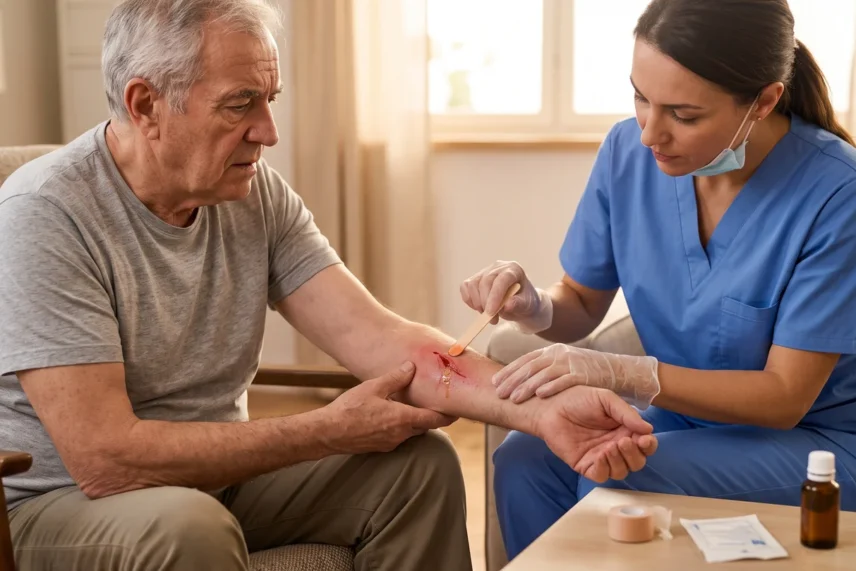
CLM Community Support notes that skin tears can look minor but may still warrant professional assessment — particularly when the wound is large, still bleeding, missing skin, or showing signs of infection.
Why Older Adults May Need Extra Wound Care Support
As skin ages, it becomes thinner, less elastic, and more fragile. Blood supply to the skin can also reduce, which affects how efficiently wounds heal. For older adults living in Bundaberg and the Wide Bay, a wound that a younger person might manage readily at home may warrant professional attention and appropriate wound management.
The presence of other health conditions, medications, or reduced mobility can compound these factors — meaning that what appears to be a straightforward wound may need more careful management than it initially suggests.
Repeated Skin Tears Should Not Be Ignored
If someone is experiencing repeated skin tears, professional assessment should look beyond the individual wound to consider contributing factors, including:
- Skin condition and hydration
- Home environment — furniture, sharp edges, fall risks
- Transfers and how the person moves
- Equipment such as mobility aids or bed rails
- Daily skin care routine
- Other health factors that may be increasing skin fragility
For further information, our article on skin tear care in older adults outlines practical steps in the first hour following a skin tear.
Professional wound care can support ongoing monitoring, appropriate dressing management, and identification of strategies to reduce the risk of further skin tears.
10. You Have a Health Condition That Can Affect Wound Healing
For some people, the threshold for seeking professional wound assessment should be lower — because their health conditions mean that wounds carry greater risk of complications than they might for someone in otherwise good health.
People who may benefit from professional wound assessment sooner rather than later include those with:
- Diabetes, which can affect circulation, sensation, and immune response
- Poor circulation or peripheral vascular disease
- Conditions affecting immunity, such as those taking immunosuppressant medications
- Reduced mobility, which can affect circulation and the ability to relieve pressure on wound sites
- Certain chronic health conditions that affect tissue repair or immune function
- A personal history of wound healing problems, including previous wound complications
Why Diabetes Can Make Wound Care More Important
People living with diabetes have a higher risk of wound complications, particularly on the lower limbs and feet. Reduced sensation can mean that wounds are not noticed promptly, while reduced circulation can impair the healing process. This combination means that what might be a relatively minor wound in another person can progress more quickly in someone with diabetes.
This is why professional wound monitoring and management is particularly important for people with diabetes — and why it is worth seeking assessment early rather than waiting to see whether a wound improves.
CLM Community Support is a provider under the Australian Government’s Chronic Wound Consumables Scheme, which supports eligible Australians with diabetes and a chronic wound to access wound care consumables. If you or someone you support may be eligible, speaking with a GP or healthcare professional is a good first step.
When Is a Wound an Emergency?
Some injuries require immediate emergency medical treatment — not a scheduled wound care appointment, and not a GP visit the following day. It is important to be clear about this distinction.
Call 000 for a Serious or Life-Threatening Injury
Call 000 immediately if someone has:
- Severe or uncontrolled bleeding that cannot be managed with direct pressure
- Lost consciousness or is unresponsive
- Sustained a serious traumatic injury — such as a significant fall, motor vehicle accident, or injury involving machinery
- Signs of shock, including pallor, rapid or weak pulse, confusion, or collapse
- Major damage to a limb or body part
- A wound associated with another potentially life-threatening injury
CLM Community Support’s wound care service is not a substitute for emergency medical treatment. If you are uncertain whether a situation is an emergency, calling 000 is always the right choice.
When Should You See a GP or Healthcare Professional?
Between emergency situations and ongoing wound management, there is an important middle ground — wounds that warrant a visit to your GP, an urgent care centre, or an emergency department (if your GP is unavailable and the wound is significant).
Consider seeing a GP or appropriate healthcare professional if:
- The wound appears to be becoming infected
- The wound is not healing as expected
- The wound is deep, complicated, or in a sensitive location
- You have health conditions that may affect healing, such as diabetes or poor circulation
- Pain is worsening rather than improving
- The wound keeps reopening
- There is uncertainty about how serious the wound is, or whether it requires closure
Your GP can assess the wound, determine whether treatment such as antibiotics is needed, arrange referral to specialist wound care, and help manage any underlying health factors affecting healing.
What Does Professional Wound Care Involve?
Professional wound care is not simply about applying a dressing. For complex, chronic, or difficult-to-manage wounds, it involves a structured and ongoing approach to assessment, treatment, and monitoring.
To understand more about this in detail, Our article on what a wound care nurse does explains the scope of professional wound nursing and what people can expect.
Wound Assessment
A professional wound assessment considers:
- The type and cause of the wound
- Its size, depth, and appearance
- The condition of the surrounding skin
- Signs of infection or other complications
- The wound’s healing progress
- Relevant health factors, such as underlying conditions or medications
Assessment forms the foundation for all other wound management decisions.
Dressing and Wound Management
Appropriate wound management includes selecting and applying dressings suited to the individual wound — taking into account factors such as the level of exudate, the wound type, the person’s skin sensitivity, and their broader care needs. Not all wound dressings are interchangeable, and the wrong choice can impede healing.
Monitoring Wound Healing
Regular follow-up allows a wound care professional to identify changes — both improvements and signs of deterioration — and adjust the management approach accordingly. This is particularly important for chronic or complex wounds that may take weeks or months to heal.
Coordinating With the Broader Healthcare Team
Effective wound care rarely happens in isolation. CLM Community Support’s wound care service emphasises communication and coordination with GPs, specialists, and allied health professionals — ensuring that wound management fits within the person’s broader health care. This includes supporting individualised nursing care plans that bring together wound management, medication management, and coordination with the person’s healthcare team.
For people with more complex nursing care needs, wound care may form one component of a broader package of nursing support.
Professional Wound Care at Home in Bundaberg and the Wide Bay
For people in Bundaberg and the Wide Bay region who need professional wound care, CLM Community Support provides wound care services delivered in the home — meaning care comes to the person rather than requiring them to travel.
Wound care at CLM Community Support is provided by Registered Nurse Linda Miller, who brings experience across acute, chronic, community, and aged care settings, including wound assessment, management, and care planning. Care can support people recovering from surgery, managing chronic wounds, or dealing with acute injuries — with an approach tailored to the individual’s needs and circumstances.
Home-based wound care can be particularly valuable for people who find it difficult to travel, who require regular monitoring, or whose wound management needs are ongoing. Linda works alongside each person’s broader healthcare team, helping to ensure that wound care is coordinated and consistent.
CLM Community Support is based in Bundaberg and serves clients across the Wide Bay region.
Who Can Benefit From Professional Wound Care?
Professional wound care in Bundaberg and the Wide Bay may be relevant for:
- Older adults managing wounds on fragile or ageing skin
- People recovering from surgery who need ongoing wound monitoring and dressing management
- People living with chronic wounds, including leg ulcers, pressure injuries, or diabetic foot wounds
- NDIS participants who require nursing wound care support as part of their plan
- Aged care clients receiving community-based support
- People with limited mobility who benefit from care delivered in the home
- Families supporting someone with a wound that is difficult to manage without nursing assistance
Why Choose Home-Based Wound Care?
Receiving wound care at home offers several practical advantages. Care is delivered in a familiar environment, reducing the stress and logistical challenges that can accompany travel — particularly for people with mobility limitations or complex health needs. Home visits also allow the care provider to observe the person’s environment and daily routine, which can inform the broader wound management approach.
Continuity of care matters for wound healing. Regular visits from a consistent, familiar nurse support trust, allow for careful monitoring of changes over time, and help ensure that the right adjustments are made when needed.
Don’t Ignore a Wound That Is Getting Worse
The signs a wound needs professional medical attention are not always dramatic. Some of the most important warning signs — gradually spreading redness, slowly worsening pain, a wound that simply is not progressing — can develop quietly over several days.
The key signs to watch for include:
- Persistent bleeding that does not respond to direct pressure
- Increasing pain rather than gradual improvement
- Redness or swelling that is spreading or worsening
- Signs of an infected wound — including warmth, discharge, odour, or fever
- Unusual drainage or a sudden change in wound appearance
- A wound that is slow to heal or appears to be getting worse
- Deep or gaping wounds that may need closure
- Wounds that repeatedly reopen
- Wounds on fragile or ageing skin
- Underlying health conditions that may affect healing, such as diabetes or poor circulation
If you are unsure whether a wound is healing normally, getting professional advice is safer than waiting for it to deteriorate. Early assessment can prevent complications and support the best possible healing outcome.
Need professional wound care in Bundaberg or the Wide Bay? CLM Community Support provides Registered Nurse-led wound care for people dealing with acute injuries, chronic wounds, and post-surgical recovery, with home-based support available across the region.
Learn more about CLM Community Support’s wound care services in Bundaberg and the Wide Bay.
Frequently Asked Questions About Wound Care
How do I know if a wound needs medical attention?
Consider the wound’s size, depth, and location. A wound that is deep, gaping, heavily bleeding, or in a sensitive area such as the face, hands, or feet warrants professional assessment. Signs of infection — including increasing redness, warmth, swelling, pain, or discharge — are also important reasons to seek advice. A wound that is not healing as expected, or that keeps reopening, should be assessed by a healthcare professional. Healthdirect Australia’s information on wounds, cuts, and grazes provides useful general guidance.
What are the signs of an infected wound?
Common wound infection symptoms include increasing redness (particularly redness that is spreading away from the wound), warmth in the surrounding skin, increasing swelling, worsening pain, discharge that is thick, cloudy, green, or yellow, a foul smell from the wound, and systemic symptoms such as fever, chills, or feeling generally unwell. If you notice these signs, professional assessment is recommended.
How long should a wound take to heal?
Healing time varies considerably depending on the type, size, and location of the wound, as well as the person’s overall health, age, and any underlying conditions. Minor cuts and abrasions may heal within a week or two, while larger, deeper, or chronic wounds may take considerably longer. If a wound does not appear to be progressing — or if it seems to be getting worse rather than better — it is worth seeking professional assessment rather than waiting for an arbitrary timeframe to pass.
When should I see a doctor for a cut?
See a doctor or go to urgent care if the cut is deep, wide, or gaping; if it will not stop bleeding with direct pressure; if it was caused by a contaminated or dirty object; if it shows signs of infection; if it is in a sensitive location such as near a joint, the eye, or the hand; or if you are uncertain whether it requires closure. People with health conditions such as diabetes should have a lower threshold for seeking medical advice about cuts and wounds.
Can a wound care nurse treat a wound at home?
Yes. A Registered Nurse with wound care experience can provide professional wound assessment, appropriate dressing management, and wound monitoring in the home. Home-based nursing wound care is particularly useful for people with limited mobility, chronic wounds, or complex wound management needs. It is important to note that home wound care is not a substitute for emergency medical treatment — if a wound is a medical emergency, call 000.
What should I do if a wound is not healing?
If a wound is not showing signs of improvement, is getting worse, or keeps reopening, arrange an assessment with your GP. A healthcare professional can assess whether there is an underlying reason for delayed healing — such as infection, poor circulation, or a health condition affecting wound repair — and determine whether specialist wound care is appropriate. Do not leave a non-healing wound unassessed, particularly if you have diabetes or other health conditions that affect healing.
Can older adults need professional wound care for a skin tear?
Yes. Skin tears in older adults can look minor but may still warrant professional wound assessment, particularly when the tear is large, still bleeding, involves missing skin, or is showing signs of infection. Fragile and ageing skin can make wound management more complicated, and repeated skin tears may indicate that a broader assessment of skin condition and contributing factors is needed.
Does diabetes affect wound healing?
Diabetes can affect wound healing in several ways, including by impairing circulation, reducing the body’s immune response, and affecting sensation — meaning wounds may not be noticed promptly. People with diabetes are at greater risk of wound complications, particularly on the lower limbs and feet. Professional wound monitoring and management is often particularly important for people with diabetes, and seeking early assessment when a wound does not seem to be progressing is strongly recommended. CLM Community Support is a provider under the Australian Government’s Chronic Wound Consumables Scheme, which supports eligible Australians with diabetes and a chronic wound.
Taking Wound Care Seriously — Because Healing Matters
Understanding the signs a wound needs professional medical attention is not about creating unnecessary worry. It is about knowing when to act, knowing who to contact, and knowing that early assessment is usually better than waiting for a wound to deteriorate before seeking help.
For people living in Bundaberg and the Wide Bay, access to professional wound care in the home means that appropriate, Registered Nurse-led wound management is closer than many people realise. Whether you are recovering from surgery, managing a chronic wound, supporting an older family member with recurring skin tears, or simply unsure whether a wound is healing as it should — getting a professional assessment is a straightforward step that can make a meaningful difference.
If you would like to find out more about wound care services available through CLM Community Support in Bundaberg and the Wide Bay, we welcome you to get in touch with our team.
Related Articles: What Is the Chronic Wound Consumables Scheme and Am I Eligible? | Daily Wound Care Bandage Support | What Does a Wound Care Nurse Do? | Skin Tears in Older Adults: What to Do in the First Hour