-
Linda Miller
- September 9, 2026
- No Comments
A knock against a door frame. A hand caught on the corner of a coffee table. Help getting out of a chair, and suddenly there is a flap of loose skin and more blood than seems reasonable for such a small accident.
Skin tears happen quickly and they can look alarming, particularly on the thin, fragile skin many older adults have. For families in Bundaberg and the Wide Bay region, the immediate question is usually the same: is this something we manage at home, or does it need a nurse?
This guide explains what to do in the first hour after a skin tear, what to avoid, when professional assessment is warranted, and how to reduce the chance of it happening again.
In short: protect the wound, gently control any bleeding, do not throw away or cut off an attached skin flap, avoid sticky plasters on fragile skin, and arrange assessment by a nurse or GP if the tear is large, still bleeding, missing skin, or showing signs of infection.
What to Do in the First Hour
1. Stay calm and protect the area
The first minutes matter less for treatment than they do for preventing further damage. Help the person into a comfortable, seated position and support the injured limb so it is not knocked again.
Wash your hands before you touch the wound or anything that will contact it. If disposable gloves are available, use them. Avoid handling the wound itself more than necessary.
2. Gently control any bleeding
Skin tears can bleed more than their size suggests, particularly if the person takes blood-thinning medication. Apply gentle, steady pressure with a clean, non-fluffy cloth or dressing pad. Raising the limb, where it is comfortable and safe to do so, can also help.
If bleeding is heavy, soaks through repeatedly, or does not settle with sustained pressure, seek urgent medical assistance rather than continuing to wait.
3. Do not throw away the skin flap
This is the single most important thing to get right.
If a flap of skin is still attached, leave it attached. Do not cut it off, pull it away, or tuck it out of the way. That flap is living tissue, and where it remains viable, a healthcare professional may be able to assess it and carefully reposition it over the wound to protect the exposed area underneath.
Once the flap is discarded, that option is gone. Many people remove it instinctively because it looks untidy or in the way. Leave it where it is and let a nurse or GP assess it.
4. Cover the wound appropriately
If there is visible dirt or debris in the wound, rinse it gently first with cool clean running water or sterile saline, letting the water run over the area rather than directing pressure at it.
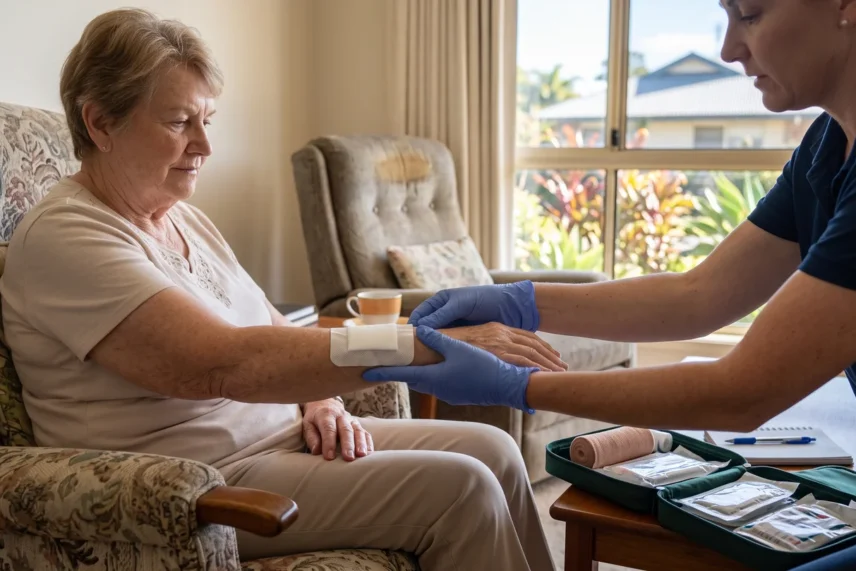
Then cover the area with a clean, non-adherent dressing — the type that does not stick to the wound surface — and secure it with a light tubular or conforming bandage rather than tape applied to the skin.
Ordinary adhesive plasters are not suitable for fragile older skin. The adhesive frequently causes a second tear when it is removed, sometimes larger than the original injury.
If you do not have a non-adherent dressing in the house, a clean, dry, non-fluffy pad held gently in place is a reasonable interim measure until the wound can be assessed.
5. Note what happened
Before the moment passes, jot down three things: the date and time the injury occurred, how it happened, and — if a flap is present — which direction it lies in.
This takes thirty seconds and is genuinely useful to whoever assesses the wound. It helps establish how long the tissue has been exposed, identifies a hazard worth addressing, and means the nurse does not have to work out flap orientation from a dressing that has already been disturbed.
6. Arrange professional assessment
Many skin tears benefit from being seen by a registered nurse or GP, particularly in older adults or anyone with fragile skin, diabetes, circulation problems, or a history of slow-healing wounds.
Professional assessment determines whether the flap can be preserved, what dressing suits the wound, and how often it needs reviewing. Getting this right early tends to prevent a small injury from becoming a long-term wound.
What Not to Do
Don’t discard an attached skin flap
Worth repeating, because it is the most common and most consequential mistake.
Don’t scrub the wound
Rinsing gently is appropriate. What causes damage is scrubbing, wiping firmly, or using antiseptics such as hydrogen peroxide or strong iodine — all of which harm the fragile tissue that is trying to heal.
Force matters more than water here. Directing a strong stream at the wound can wash away a skin flap that would otherwise have been salvageable, so let the water run gently over the area rather than aiming at it.
Don’t pull or tear away remaining skin
Loose edges may look untidy. Removing them removes tissue the body can still use.
Don’t apply adhesive products directly to fragile skin
Plasters, strapping and strong medical tapes all risk causing further tearing on removal. If a dressing needs securing, a tubular bandage or conforming bandage is a safer choice, and a nurse can advise on appropriate products.
Don’t repeatedly disturb the wound to check on it
Every time a dressing is lifted, the wound surface is disrupted and healing is set back. Follow the review schedule a healthcare professional recommends rather than looking daily out of concern.
Don’t stop prescribed medication
Anticoagulants, antiplatelet medications and corticosteroids can all make skin more fragile or bleeding more pronounced. That is not a reason to stop or adjust them. Only the prescribing doctor should make that decision. If someone on blood-thinning medication has a skin tear that is bleeding persistently, that warrants prompt review rather than watchful waiting.
What a Skin Tear Is, and How Serious It Is
A skin tear is a traumatic wound caused by friction, shear or blunt force separating the layers of the skin. The outer layer may peel back from the layer beneath, sometimes remaining attached as a flap, sometimes coming away entirely.
They occur most often on the forearms, the backs of the hands, the lower legs and shins, and around the elbows — the areas most exposed to knocks, friction and handling during transfers.
Clinicians commonly describe skin tears using three categories, based on how much of the flap remains:
- Type 1 — the skin flap is present and can be repositioned to cover the wound
- Type 2 — part of the skin flap has been lost
- Type 3 — the skin flap is completely absent and the wound bed is exposed
This classification exists so that healthcare professionals can describe the wound consistently and choose appropriate management. It is useful for families to know it exists, but assessing and classifying a wound is a clinical task, not something to attempt at home.
Not every skin tear is a medical emergency. Many are small, settle with appropriate cover, and heal without complication. But older skin heals more slowly, and a skin tear that is poorly managed in the first days can develop into a wound that takes weeks or months to close. Potential complications include ongoing bleeding, infection, stalled healing, persistent pain, and reduced mobility while the wound is protected.
The sensible position sits between panic and dismissal: treat it as a real wound that deserves proper assessment, not as a graze.
Why Older Adults Get Skin Tears So Easily
Thinning skin
The outer layers of skin become thinner with age and the junction between the layers flattens, which means they separate more readily under force that younger skin would absorb without injury.
Reduced elasticity
Skin loses collagen and elastin over time. Less elastic skin stretches less before it tears.
Less padding underneath
The layer of fat beneath the skin thins with age, particularly on the forearms and shins. There is simply less cushioning between a bony surface and the corner of a table.
Dry or fragile skin
Dry skin is more brittle and more easily damaged. This is one of the few risk factors that responds well to a simple daily habit, which is why moisturising features so prominently in prevention.
Medications
Long-term corticosteroid use can thin the skin. Anticoagulant and antiplatelet medications do not cause tears, but they make bleeding and bruising more pronounced when one occurs. These medications are prescribed for good reasons and should never be altered because of skin fragility — but it is worth mentioning them to whoever assesses the wound.
Everyday activities
Most skin tears happen during entirely ordinary moments: bumping a hallway wall, catching an arm on a door frame, transferring between bed and chair, being helped with dressing or undressing, manoeuvring a walker or wheelchair, or having an adhesive dressing removed.
When to Call a Nurse
Arrange professional assessment if the skin tear:
- Is large, deep, or has a flap that is partially or completely missing
- Continues to bleed after sustained gentle pressure
- Is very painful, or the pain is increasing rather than settling
- Shows signs of infection — spreading redness, swelling, warmth, increasing pain, pus or unusual discharge, an unpleasant odour, fever, or generally feeling unwell
- Occurs in someone with diabetes, poor circulation, or a history of wounds that heal slowly
- Is not improving, or has started to deteriorate after initially settling
Seek urgent medical care for heavy bleeding that cannot be controlled, red streaks spreading from the wound, or signs of serious infection.
A registered nurse assessing a skin tear will examine the wound and the surrounding skin, evaluate whether the flap is viable, consider factors that may delay healing, select appropriate wound care products, and establish a schedule for monitoring and review. They can also communicate with the person’s GP where medical input is needed.
How Long Does a Skin Tear Take to Heal?
There is no single answer, and any source offering one should be treated with caution. Healing time depends on the size and depth of the wound, its location, how much of the skin flap was preserved, the person’s general health and circulation, their nutrition and hydration, their mobility, their medications, and whether infection develops.
A small Type 1 tear with an intact flap on someone in good general health may close within a couple of weeks. A Type 3 tear on the shin of someone with poor circulation may take considerably longer and require ongoing professional management.
What matters more than the timeframe is the direction of travel. A wound that is gradually getting smaller and less painful is progressing. A wound that has stalled, enlarged, or become more painful needs reassessment — regardless of how long it has been there.
Preventing the Next Skin Tear
A skin tear is often a signal. If one has happened, the conditions that produced it usually still exist.
Keep skin moisturised
Applying a suitable moisturiser to the arms and legs twice daily is one of the most effective and least complicated prevention measures available. Fragrance-free products are generally better tolerated on sensitive skin.
Clear the environment
Walk through the home and look for the specific hazards: sharp furniture corners, narrow gaps between furniture, clutter along walking paths, protruding door handles, and poorly lit hallways. Padding a coffee table corner is a small intervention that prevents a real injury.
Slow down during transfers
Bed to chair, chair to standing, in and out of the car, in and out of the shower. Rushing a transfer is a common cause of skin tears, and the fix is usually just allowing more time and using a proper technique rather than gripping a forearm.
Check mobility equipment
Walking frames, wheelchairs and shower chairs all have edges, footplates and brackets that make contact with skin. Worn padding and exposed metal are worth checking periodically.
Protect vulnerable areas
Long sleeves and long trousers offer straightforward protection for the forearms and shins. Protective sleeves and limb protectors are also available, and a nurse or occupational therapist can advise on what suits the individual.
Take care with clothing and adhesives
Pulling a sleeve firmly over a fragile forearm can be enough to cause a tear. So can removing an adhesive dressing in the wrong direction. Both are worth slowing down for.
Support good nutrition and hydration
Adequate protein, vitamins and fluid intake support skin integrity and wound healing. Nutrition alone will not prevent skin tears, but poor nutrition makes both the skin more vulnerable and healing slower.
Watch for repeat injuries
If someone is experiencing skin tears repeatedly, that pattern is worth investigating rather than treating one wound at a time. Recurring tears often point to a specific hazard, a transfer technique that needs adjusting, a piece of equipment causing friction, or a broader change in skin condition that warrants clinical review.
How CLM Community Support Can Help
Registered nursing support at home
Our Registered Nurse, Linda Miller, provides professional wound assessment and management for clients across Bundaberg, Bargara and the wider Wide Bay region. Wound care is delivered in the comfort of the person’s own home, which removes the need to travel to a clinic with a fresh wound — something that matters considerably for people with limited mobility.
Individualised nursing care plans
Wound management works best as part of a broader picture of a person’s health. Our nursing care plans incorporate wound and skin management alongside medication management, monitoring of existing health conditions, and coordination with the person’s GP and allied health team.
Support for people with fragile skin
Good care addresses the next wound as well as the current one. That means looking at the environment, the transfers, the equipment and the daily skin care routine — not just changing a dressing and leaving.
Local, person-centred care
CLM Community Support is locally owned and operated, and our team understands the practical realities of accessing health services in regional Queensland. We work alongside GPs, specialists, allied health professionals and family members to make sure care is joined up, and we deliver it with integrity, professionalism, and heart.
Frequently Asked Questions
Should you put a plaster on a skin tear?
Generally, no. Adhesive plasters are poorly suited to fragile older skin, because removing them can cause a second tear — sometimes larger than the original. A non-adherent dressing secured with a tubular or conforming bandage is a more appropriate choice, and a nurse can advise on suitable products.
Can medications make skin tears more likely?
They can contribute. Long-term corticosteroid use is associated with thinner skin, and anticoagulant or antiplatelet medications make bleeding and bruising more pronounced when an injury occurs. This is worth mentioning to whoever assesses the wound, but it is never a reason to stop or change prescribed medication without medical advice.
Can a community nurse treat a skin tear at home?
Yes. Skin tears are among the most common reasons older adults need a visit from a community nurse, and most can be assessed and managed in the person’s home. Home nursing does not replace emergency care — heavy bleeding, spreading infection or rapid deterioration need urgent medical attention.
Are skin tears a sign of something more serious?
A single skin tear is usually just an accident. Repeated skin tears are a signal worth acting on — they may indicate increasingly fragile skin, an environmental hazard, an unsafe transfer technique, a medication effect, or a change in general health. A nursing assessment can help identify which.
What if the skin tear has already been covered with a plaster?
Do not pull it off quickly. Removing adhesive from fragile skin causes further damage. If it is causing a problem, a nurse or GP can remove it safely using an appropriate technique or adhesive remover.
Caring for Fragile Skin in Bundaberg and the Wide Bay
A skin tear can look minor and still deserve proper attention. Four things are worth remembering: protect the wound from further trauma, never discard an attached skin flap, keep adhesive plasters away from fragile skin, and arrange professional assessment when the wound is significant, still bleeding, not healing, or showing signs of infection.
If an older family member has experienced a skin tear, is having them repeatedly, or needs ongoing wound care support at home, the nursing team at CLM Community Support can help. We serve Bundaberg, Bargara and surrounding Wide Bay communities, and we would be glad to discuss what support would suit your situation.
Call Us: +0478 077 538
Medical Disclaimer: This article is intended for general educational purposes only and does not constitute medical advice. Wound care needs vary significantly between individuals depending on wound type, severity and underlying health conditions. Always seek assessment from a qualified healthcare professional for any wound that is bleeding heavily, not healing, or showing signs of infection. For urgent medical concerns, contact your GP, call 13 HEALTH (13 43 25 84) in Queensland, or dial 000 in an emergency.